

|
Application areasThere are many possible application areas for BCEL ranging from class browsers, profilers, byte code optimizers, and compilers to sophisticated run-time analysis tools and extensions to the Java language.
Compilers like the Barat compiler use BCEL to implement a byte code generating back end. Other possible application areas are the static analysis of byte code or examining the run-time behavior of classes by inserting calls to profiling methods into the code. Further examples are extending Java with Eiffel-like assertions, automated delegation, or with the concepts of Aspect-Oriented Programming. Class loaders
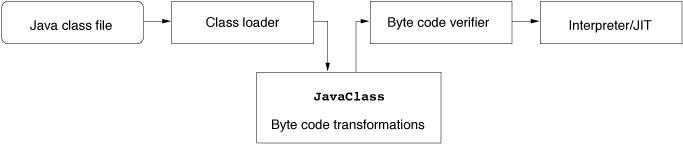
Class loaders are responsible for loading class files from the file system or other resources and passing the byte code to the Virtual Machine. A custom A possible scenario is described in figure 7: During run-time the Virtual Machine requests a custom class loader to load a given class. But before the JVM actually sees the byte code, the class loader makes a "side-step" and performs some transformation to the class. To make sure that the modified byte code is still valid and does not violate any of the JVM's rules it is checked by the verifier before the JVM finally executes it.
Using class loaders is an elegant way of extending the Java Virtual Machine with new features without actually modifying it. This concept enables developers to use load-time reflection to implement their ideas as opposed to the static reflection supported by the Java Reflection API. Load-time transformations supply the user with a new level of abstraction. They are not strictly tied to the static constraints of the original authors of the classes but may customize the applications with third-party code in order to benefit from new features. Such transformations may be executed on demand and neither interfere with other users, nor alter the original byte code. In fact, class loaders may even create classes ad hoc without loading a file at all. Example: Poor Man's Genericity
The former "Poor Man's Genericity" project that extended Java with parameterized classes, for example, used BCEL in two places to generate instances of parameterized classes: During compile-time (with the standard
|