


2 Data Generation
2.1 Overview
The Commons Math o.a.c.m.random
package includes utilities for
- generating random numbers
- generating random vectors
- generating random strings
- generating cryptographically secure sequences of random numbers or
strings
- generating random samples and permutations
- analyzing distributions of values in an input file and generating
values "like" the values in the file
- generating data for grouped frequency distributions or
histograms
These utilities rely on an underlying "source of randomness", which in most
cases is a pseudo-random number generator (PRNG) that produces sequences
of numbers that are uniformly distributed within their range.
Commons Math depends on Commons Rng
for the PRNG implementations.
A PRNG algorithm is often deterministic, i.e. it produces the same sequence
when initialized with the same "seed".
This property is important for some applications like Monte-Carlo simulations,
but makes such a PRNG often unsuitable for cryptographic purposes.
2.2 Random Deviates
- Random sequence of numbers from a probability distribution
-
There is no such thing as a single "random number." What can be
generated are sequences of numbers that appear to be random. When
using the built-in JDK function Math.random(), sequences of
values generated follow the
Uniform Distribution, which means that the values are evenly spread
over the interval between 0 and 1, with no sub-interval having a greater
probability of containing generated values than any other interval of the
same length. The mathematical concept of a
probability distribution basically amounts to asserting that different
ranges in the set of possible values of a random variable have
different probabilities of containing the value. Commons Math supports
generating random sequences from each of the distributions defined in the
o.a.c.m.distribution package.
Please refer to the specific documentation
for more details.
- Cryptographically secure random sequences
-
It is possible for a sequence of numbers to appear random, but
nonetheless to be predictable based on the algorithm used to generate the
sequence.
When in addition to randomness, strong unpredictability is
required, a
secure random number generator
should be used to generate values (or strings), for example an instance of
the JDK-provided SecureRandom generator.
In general, such secure generator produce sequence based on a source of
true randomness, and sequences started with the same seed will diverge.
The RandomUtils
class provides a method for wrapping a java.util.Random or
java.security.SecureRandom instance in an object that implements
the
UniformRandomProvider interface:
UniformRandomProvider rg = RandomUtils.asUniformRandomProvider(new java.security.SecureRandom());
2.3 Random Vectors
Some algorithms require random vectors instead of random scalars. When the
components of these vectors are uncorrelated, they may be generated simply
one at a time and packed together in the vector. The
UncorrelatedRandomVectorGenerator class simplifies this
process by setting the mean and deviation of each component once and
generating complete vectors. When the components are correlated however,
generating them is much more difficult. The
CorrelatedRandomVectorGenerator class provides this service. In this
case, the user must set up a complete covariance matrix instead of a simple
standard deviations vector. This matrix gathers both the variance and the
correlation information of the probability law.
The main use for correlated random vector generation is for Monte-Carlo
simulation of physical problems with several variables, for example to
generate error vectors to be added to a nominal vector. A particularly
common case is when the generated vector should be drawn from a
Multivariate Normal Distribution.
- Generating random vectors from a bivariate normal distribution
-
// Import common PRNG interface and factory class that instantiates the PRNG.
import org.apache.commons.rng.UniformRandomProvider;
import org.apache.commons.rng.RandomSource;
// Create (and possibly seed) a PRNG (could use any of the CM-provided generators).
long seed = 17399225432L; // Fixed seed means same results every time
UniformRandomProvider rg = RandomSource.create(RandomSource.MT, seed);
// Create a GaussianRandomGenerator using "rg" as its source of randomness.
GaussianRandomGenerator rawGenerator = new GaussianRandomGenerator(rg);
// Create a CorrelatedRandomVectorGenerator using "rawGenerator" for the components.
CorrelatedRandomVectorGenerator generator =
new CorrelatedRandomVectorGenerator(mean, covariance, 1.0e-12 * covariance.getNorm(), rawGenerator);
// Use the generator to generate correlated vectors.
double[] randomVector = generator.nextVector();
...
The mean argument is a double[] array holding the means
of the random vector components. In the bivariate case, it must have length 2.
The covariance argument is a RealMatrix, which has to
be 2 x 2.
The main diagonal elements are the variances of the vector components and the
off-diagonal elements are the covariances.
For example, if the means are 1 and 2 respectively, and the desired standard deviations
are 3 and 4, respectively, then we need to use
double[] mean = {1, 2};
double[][] cov = {{9, c}, {c, 16}};
RealMatrix covariance = MatrixUtils.createRealMatrix(cov);
where "c" is the desired covariance. If you are starting with a desired correlation,
you need to translate this to a covariance by multiplying it by the product of the
standard deviations. For example, if you want to generate data that will give Pearson's
R of 0.5, you would use c = 3 * 4 * 0.5 = 6.
In addition to multivariate normal distributions, correlated vectors from multivariate uniform
distributions can be generated by creating a
UniformRandomGenerator
in place of the
GaussianRandomGenerator above. More generally, any
NormalizedRandomGenerator
may be used.
- Low discrepancy sequences
-
There exist several quasi-random sequences with the property that for all values of N, the subsequence
x1, ..., xN has low discrepancy, which results in equi-distributed samples.
While their quasi-randomness makes them unsuitable for most applications (i.e. the sequence of values
is completely deterministic), their unique properties give them an important advantage for quasi-Monte Carlo simulations.
Currently, the following low-discrepancy sequences are supported:
// Create a Sobol sequence generator for 2-dimensional vectors
RandomVectorGenerator generator = new SobolSequence(2);
// Use the generator to generate vectors
double[] randomVector = generator.nextVector();
...
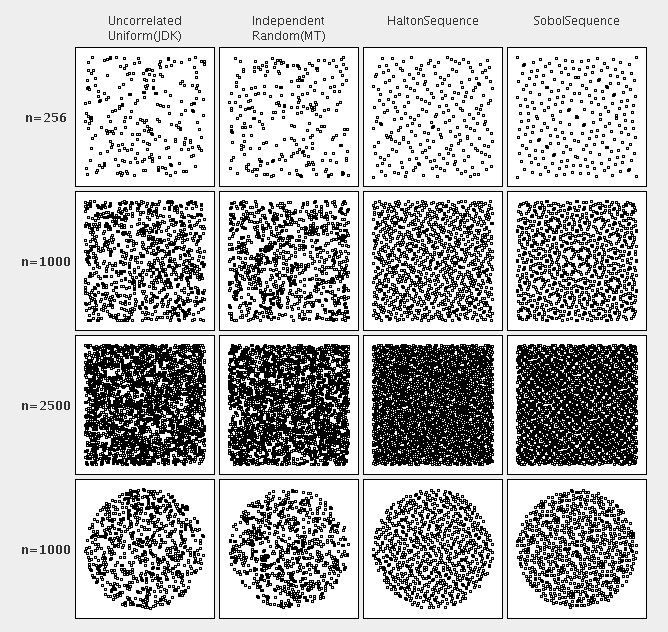
The figure below illustrates the unique properties of low-discrepancy sequences when
generating N samples in the interval [0, 1]. Roughly speaking, such sequences "fill"
the respective space more evenly which leads to faster convergence in quasi-Monte Carlo
simulations.
2.4 Random Strings
The method nextHexString in
RandomUtils.DataGenerator can be used to generate random strings of
hexadecimal characters.
It produces sequences of strings with good dispersion properties.
A string can be generated in two different ways, depending on the value
of the boolean argument passed to the method (see the Javadoc for more
details).
2.5 Random Permutations, Combinations, Sampling
To select a random sample of objects in a collection, you can use the
nextSample method provided by in
RandomUtils.DataGenerator.
Specifically, if c is a java.util.Collection<T>
containing at least k objects, and randomData is a
RandomUtils.DataGenerator instance randomData.nextSample(c, k)
will return an List<T> instance of size k
consisting of elements randomly selected from the collection.
If c contains duplicate references, there may be duplicate
references in the returned array; otherwise returned elements will be
unique (i.e. the sampling is without replacement among the object
references in the collection).
If n and k are integers with k < n, then
randomData.nextPermutation(n, k) returns an int[]
array of length k whose whose entries are selected randomly,
without repetition, from the integers 0 through
n-1 (inclusive).
2.6 Generating data like an input file
Using the EmpiricalDistribution class, you can generate data based on
the values in an input file:
int binCount = 500;
EmpiricalDistribution empDist = new EmpiricalDistribution(binCount);
empDist.load("data.txt");
RealDistribution.Sampler sampler = empDist.createSampler(RandomSource.create(RandomSource.MT));
double value = sampler.nextDouble();
The entire input file is read and a probability density function is estimated
based on data from the file.
The estimation method is essentially the
Variable Kernel Method with Gaussian smoothing.
The created sampler will return random values whose probability distribution
matches the empirical distribution (i.e. if you generate a large number of
such values, their distribution should "look like" the distribution of the
values in the input file.
The values are not stored in memory in this case either, so there is no limit to the
size of the input file.
|